|
Our Product Range
|
 |
 |
Home »
Info
Center » Fluid Flow
Fluid Flow
The fluid in a hydraulic system is
normally under pressure and completely fills the pipes of the system. This
pressure may result from friction within the piping system, from gravity or
the weight of the fluid, or from load resistance to the pump flow.
When a hydraulic fluid flows through straight piping at low velocity, then
the particles of the liquid move in straight motion parallel to the
direction of flow, so that heat loss due to friction is minimal. Such flow
is referred to as laminar flow. Detrimental factors such as high flow
velocity, sharp bends and elbows in the piping, rough internal pipe
surfaces, etc. cause cross currents within the flow and turbulence starts to
develop. Turbulent flow causes significant increases in friction and a
pressure drop; thus heat is produced (input energy is wasted).
Although friction can never be eliminated entirely, it can be reduced to
some extent if the aforementioned detrimental factors are avoided or reduced
(fig. 6).

Flow through an orifice
An orifice is a hole, narrower than the
pipes to which it is fitted. The orifice is generally used to control flow,
or to create a pressure differential.
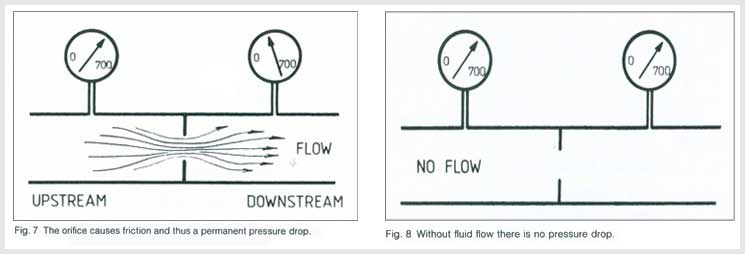
As long as there is flow through an orifice, there exists a pressure drop
across the orifice, which means that the pressure downstream — that is,
in the direction of flow (fig. 7) — is less than the pressure upstream.
There is permanent loss of pressure since the friction (work) has been
transformed into heat, and this heat cannot be regained. As soon as the flow
is stopped the Law of Pascal must be applied for the now static condition,
and pressure on both sides of the orifice equalise (fig. 8)
Flow rate and flow velocity
The average speed with which the
particles of a fluid move past a measuring point is called fluid velocity or
speed. The fluid velocity is measured in metres per second (abbreviated
m/s). Flow velocity must be carefully controlled and considered when the
hydraulic system is designed, as an excessive flow velocity causes turbulent
flow with its resulting high pressure drop.
Flow rate is the measure of flow volume that streams past a measuring point
in a given time. Flow rate is measured in litres / second (abbreviated Us)
or cubic metres per second. (The latter is less frequently used.) Flow rate
has a direct bearing on the speed with which a hydraulic actuator moves a
load and is therefore governed by the design concepts of the machine.